
Table of Contents
- Executive Summary
- The Anatomy of a Modern Pantyhose: Beyond Sheer Aesthetics
- Decoding Denier: The Primary Metric for Hosiery Yarns
- Key Polyester Filament Specifications for Hosiery
- Comparative Analysis: Nylon vs. Polyester in Hosiery Applications
- Manufacturing Processes: From Filament to Finished Garment
- Technical Specifications Table: Recommended Polyester Filament Types by Hosiery Style
- Supplier Selection Criteria: What to Look For
- Market Trends and Future Innovations
- Conclusion: Optimizing Your Hosiery Product Line
- Frequently Asked Questions (FAQ)
1. Executive Summary
For manufacturers and suppliers in intimate apparel and legwear, selecting the correct polyester filament is critical for producing pantyhose that balance aesthetics, durability, and comfort. What Denier Polyester Filament is Used for Pantyhose? This comprehensive guide details the technical specifications required for hosiery production, focusing on denier ranges, filament types, and performance characteristics. Key insights include the prevalence of ultra-fine denier filaments (below 20D) for sheer styles, the growing use of specialty polyesters for compression and shaping, and essential quality control parameters for procurement. Understanding these elements enables businesses to make informed sourcing decisions, enhance product quality, and meet evolving consumer demands.
2. The Anatomy of a Modern Pantyhose: Beyond Sheer Aesthetics
Modern pantyhose are engineered garments requiring precise material selection. While sheer appearance remains important, contemporary demands include:
- Comfort and Fit: Breathability, moisture-wicking, and elasticity.
- Durability: Resistance to runs, snags, and abrasion.
- Functional Benefits: Compression, thermal regulation, and shaping.
- Aesthetic Variety: Matte, shiny, and patterned finishes.
Polyester filament has become a dominant material due to its strength, chemical resistance, dyeability, and cost-effectiveness compared to traditional nylon.
3. Decoding Denier: The Primary Metric for Hosiery Yarns
Denier (D) is the weight in grams of 9,000 meters of filament. In hosiery:
- 5D-15D: Ultra-sheer, lightweight hosiery (evening/fashion wear).
- 15D-30D: Standard sheer hosiery (daily office wear).
- 30D-50D: Semi-opaque to opaque styles (fall/winter collections).
- 70D and above: Opaque tights, leggings, and thermal wear.
Finer deniers provide transparency but require higher filament counts and superior manufacturing to ensure strength.
4. Key Polyester Filament Specifications for Hosiery
Beyond denier, these parameters define performance:
- Filament Count: Higher filament counts within a given denier improve softness and reduce shine (e.g., 72 filaments in 20D yarn).
- Cross-Section: Round (standard), trilobal (reduced shine, softer feel), or hollow (thermal insulation).
- Luster: Bright, semi-dull, or full-dull to control sheen.
- Tenacity and Elongation: Typically 3.5-5.0 g/d tenacity and 20-35% elongation for balanced strength and stretch.
- Thermal Properties: Low melting point (LP) polyester variants are used in fusible areas for seamless construction.
5. Comparative Analysis: Nylon vs. Polyester in Hosiery Applications
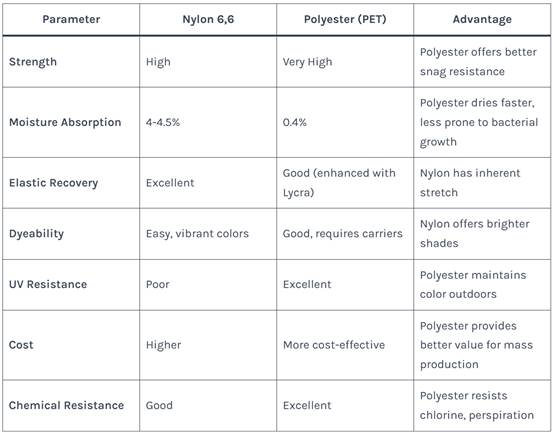
Polyester is increasingly favored for everyday hosiery due to its durability and cost, while nylon retains a niche in premium sheer styles.
6. Manufacturing Processes: From Filament to Finished Garment
- Yarn Preparation: Ultra-fine denier polyester is often texturized or air-entangled to improve coverage and opacity. It is then plied with elastane (Lycra/Spandex) yarns (typically 10-20% content) on covering or core-spinning machines.
- Knitting: Circular knitting machines (400-600 needle counts) produce the tubular fabric. Finer gauges (e.g., 40 needles per inch) create sheerer fabrics.
- Dyeing and Finishing: Dyed using disperse dyes in pressurized jet dyeing machines. Key finishes include:
- Softening: Amino-silicone softeners for slip.
- Anti-snag: Polymer coatings to prevent runs.
- Matte Finishing: Surface treatments to reduce shine.
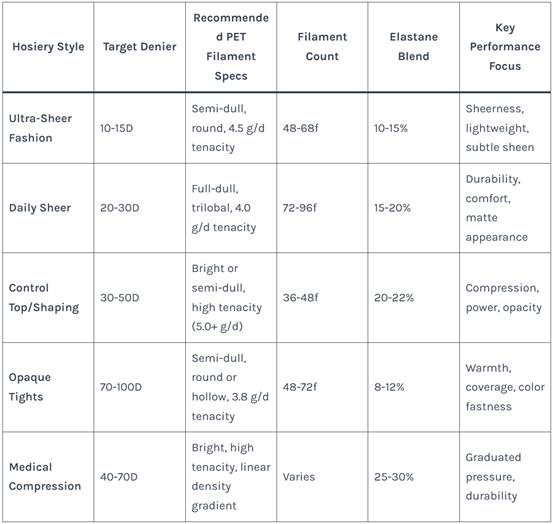
7. Technical Specifications Table: Recommended Polyester Filament Types by Hosiery Style
8. Supplier Selection Criteria: What to Look For
- Consistency in Denier: Minimal deviation (±2%) is crucial for uniform knitting.
- Low Defect Rates: Ensure less than 1% broken filaments, neps, or dyeing defects.
- Technical Support: Suppliers should provide data on dye uptake rates and knitting performance.
- Certifications: OEKO-TEX Standard 100, GRS (Global Recycled Standard) for sustainable options.
- MOQ and Lead Times: Assess compatibility with production cycles.
9. Market Trends and Future Innovations
- Sustainable Fibers: Increased demand for recycled polyester (rPET) from post-consumer bottles. rPET filaments now achieve fineness down to 15D.
- Smart Textiles: Integration of copper-ion or bamboo charcoal-infused polyester for anti-odor and antimicrobial properties.
- Enhanced Comfort: Bi-component filaments (PET/PTT) for improved stretch recovery without excessive elastane.
- Customization: Digital printing on hosiery driving demand for specially prepared polyester substrates with high dye affinity.
10. Optimizing Your Hosiery Product Line
Successful pantyhose manufacturing relies on selecting polyester filaments aligned with product positioning. For sheer fashion lines, prioritize ultra-fine, high-filament count dull yarns. For durable everyday wear, focus on higher-tenacity trilobal polyester. For performance segments, leverage specialty polyesters with enhanced functionalities. Collaborate closely with filament producers to test yarns in specific knitting and dyeing conditions, ensuring optimal performance and cost-efficiency. By mastering these technical details, manufacturers can differentiate their products in a competitive market.
11. Frequently Asked Questions (FAQ)
Q1: What is the most common denier range for everyday women’s sheer pantyhose?
A: 20-30 denier is the industry standard for daily wear, offering an optimal balance of sheerness, durability, and comfort.
Q2: Can 100% polyester be used for pantyhose, or is elastane always required?
A: Elastane (typically 10-25%) is almost always blended to provide the necessary stretch and recovery for proper fit. 100% polyester would lack adequate elasticity.
Q3: How does recycled polyester (rPET) perform compared to virgin PET in hosiery?
A: Modern rPET filaments achieve comparable fineness, strength, and dyeability. The primary difference may be a slight reduction in luster consistency, which is often desirable for matte finishes.
Q4: Why is trilobal cross-section polyester recommended for hosiery?
A: Trilobal filaments scatter light more effectively than round filaments, resulting in a softer, more matte appearance that reduces unwanted shine on the leg.
Q5: What causes “run” or “ladder” in pantyhose, and how can filament choice help?
A: Runs start from a broken filament. Using higher-tenacity polyester (4.5 g/d and above) and applying anti-snag finishes during manufacturing significantly improves run resistance.
Q6: Are there flame-retardant polyester filaments suitable for hosiery?
A: While technically possible, FR treatments are uncommon in general hosiery due to cost and hand-feel alterations. They are used only in specific protective occupational wear.
Q7: How important is filament uniformity for high-speed knitting?
A: Critical. Inconsistent denier or dye affinity leads to barre marks (horizontal stripes) in the finished fabric, resulting in high defect rates. Demand CV% (Coefficient of Variation) below 1.5% for denier.
Q8: What are “low-pill” polyester variants, and are they used in hosiery?
A: Low-pill fibers have higher molecular weight for reduced fuzzing. They are more common in heavier legwear like opaque tights but less in sheer hosiery due to different wear stresses.
Q9: How does polyester hosiery dyeing differ from nylon?
A: Polyester requires high-temperature (130°C) dyeing with carrier chemicals for dye penetration, while nylon dyes at lower temperatures (95-100°C). Polyester generally offers better colorfastness to washing.
Q10: What is the typical order lead time for specialty polyester hosiery filaments?
A: For standard specifications, lead times are 4-6 weeks. For custom denier, luster, or recycled content, lead times can extend to 8-10 weeks. Always confirm with suppliers during seasonal planning.