
Malaysia has established itself as one of the leading influential economies of the global marketplace. The export-oriented, industry-based strategic geographical location and advanced manufacturing capabilities have supported the nation’s strong participation in the global supply chain. The leadership of the economy in semiconductors, electrical and electronic products, along with palm oil, chemicals, machinery and medical devices, has positioned Malaysia as one of the global manufacturing and emerging trade hubs. The investment rates made by the government authorities in industrial modernization, digital transformation, logistics infrastructure, and smart manufacturing have strengthened international trade competitiveness. Malaysia Trade Statistics reported that the country has been a valuable supplier of business strategies for the authorities looking for international market expansion.
The shipment-level customs intelligence enables businesses to identify verified buyers and suppliers, evaluate supplier performance, and monitor competitor shipment activities. Businesses looking for service expansion can utilize the authentic customs records to make informed sourcing and investment decisions. Malaysia has been continuously playing a vital role in the global supply chain, backed up by the advanced electronic manufacturing ecosystem, strong trade relationships, and economic integrity with the United States, Japan, Thailand, South Korea, and Indonesia. The government initiatives promoting industrial development, export diversification, and sustainable manufacturing have been creating new opportunities for international businesses.
THE COMPREHENSIVE OVERVIEW OF MALAYSIA’S IMPORTS
Malaysia’s import economy has created several opportunities mainly because of the growing demand from the electronics, semiconductor, automotive, healthcare and industrial manufacturing sectors. The manufacturing-driven economy is basically reliant on the import of raw materials, semiconductor components, integrated circuits, and industrial machinery. China, Singapore, Japan, the United States, South Korea and Taiwan are the top import partners. The supply rate is getting advanced due to the manufacturing equipment, industrial machinery, and electrical components trade. Malaysia Import Data reported that comprehensive shipment-level intelligence has been a valuable tool for businesses looking for supplier information and port details.
Businesses trying to expand their services can utilize the latest intelligence to evaluate supplier reliability, with identification of cost-effective sourcing destinations and negotiation of better procurement contracts. The healthcare sector is continuously getting diversified with several imports of pharmaceutical ingredients, biotechnology products, diagnostic equipment, and advanced medical devices. The digital transformation and Industry 4.0 initiatives have been driving the import of automation systems, robotics, artificial intelligence and semiconductor manufacturing equipment.
THE EXPORT MARKET OVERVIEW OF MALAYSIA
Malaysia’s export market continues to maintain its position as one of the leading export-oriented economies. The export economy is primarily driven by high-value manufactured goods, natural resources, and processed agricultural commodities. Electrical and electronic products, integrated circuits, petroleum products, and machinery have supported the major export categories of trade from Malaysia. Industrial contribution to economic growth has supported foreign exchange earnings along with suitable revenue generation. China, Singapore, the United States, Japan, Hong Kong, and Thailand are the top trading regions. The largest export destinations of Malaysia include free trade agreements supporting the country’s export expansion. Malaysia Export Data has enabled businesses to identify international buyers, evaluate export performance, and monitor global demand patterns.
The shipment-level customs intelligence helps exporters monitor competitor activities, along with the identification of growing export markets and strengthening of international sales strategies. Malaysia’s semiconductor industry has been the strongest export contributor because of the increasing global demand for integrated circuits, electronic components, and chip packaging. The electrical and electronic sector has continuously been attracting international investment while making the service one of the major semiconductor manufacturing hubs. The palm oil industry has created substantial export revenues with a proper hike in international demand from the food processing, cosmetics, biofuel, and pharmaceutical industries. Petroleum products, liquefied natural gas, chemicals, and medical devices have been maintaining their role as important contributors towards Malaysia’s export growth. The government investment in industrial innovation, digital manufacturing and artificial intelligence has strengthened Malaysia’s export competitiveness.
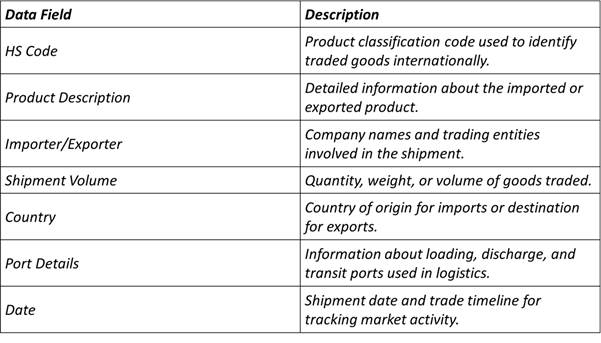
WHAT DETAILS ARE INCLUDED IN MALAYSIA CUSTOMS DATA?
THE EFFECTIVENESS OF MALAYSIA IMPORT-EXPORT DATA PROVIDERS IN BUSINESS GROWTH
Malaysia import-export data providers have become a valuable tool for business authorities looking for service expansion. The accurate customs records enable organizations to gain an understanding of changing market trends and identify profitable business opportunities. Import Globals Malaysia trade statistics offer shipment-level intelligence covering multiple industries.
Businesses looking for reliable trade data can access the imported databases, exporter profiles, and supplier information to enable authorities in establishing genuine business partnerships and monitoring competitor performance. The updated shipment records overall improve lead generation along with optimization of procurement planning and minimization of supply chain risk. The reliable customs intelligence enables organizations to make data-driven commercial decisions.
HOW DOES MALAYSIA IMPORT-EXPORT DATA SUPPORT BUSINESS GROWTH?
Malaysia import-export data is considered an indispensable tool for business authorities looking to stay progressive. The shipment-level customs intelligence enables businesses to minimize commercial risk, improve strategic planning, and identify profitable opportunities. Below are the factors that represent why Malaysia trade data supports business growth.
- Identification of verified buyers and suppliers – Businesses trying to be progressive can properly understand the buyers and suppliers worldwide with the latest acknowledgement of authentic customs records. The reliable access to verified traders of a specific category reduces the sourcing risk along with an increase in national sales and opportunities.
- Competitor shipment monitoring – Malaysia trade data enables businesses to monitor competitor shipment volumes and export destinations. The intelligence allows organizations to analyse competitor performance and strengthen their own market positioning.
- Supply chain optimization – Malaysia customs data helps the authorities with evaluation of supplier reliability, delivery of trade schedules, procurement efficiency, and shipment frequency. The companies can properly optimize procurement strategies with improvement of inventory management and strengthening of supply chain resilience.
- Market expansion opportunities – The historical shipment records help the authorities with identification of emerging industries, high-growth product categories, and attractive international markets. The companies can properly evaluate and monitor trade flows to stay progressive.
- Pricing and demand analysis – Malaysia customs trade data reported that beginner traders can properly refer to the latest trade statistics, like France, for better intelligence supporting pricing ranges and demand forecasting.
WHY IS MALAYSIA SHIPMENT DATA IMPORTANT FOR INTERNATIONAL TRADE ANALYSIS?
Malaysia shipment data is considered important for international trade analysis because it provides complete visibility for users into cross-border commercial activities. Businesses can evaluate import volumes, export destinations, and supplier performance with the movement of trade across international markets. The historical shipment records help the organizations with identification of sourcing opportunities and evaluation of competitor performance. International trade has become increasingly data-driven, and reliable customs intelligence has enabled businesses to make informed decisions while improving operational efficiency.
Malaysia shipment data has been helping exporters identify emerging overseas markets, analyse buyer purchasing behaviour, and evaluate international pricing trends. The organization has supported the trade understanding of authentic customs intelligence to help the authorities gain a competitive advantage in the changing global market conditions.
THE FUTURE TRADE OUTLOOK OF MALAYSIA TRADE INTELLIGENCE
Malaysia’s future trade outlook will be highly promising with the proper support from the continuous industrial expansion, technological innovation, and digital transformation. The government initiatives promoting semiconductor manufacturing will create significant opportunities for artificial intelligence, smart manufacturing, and logistics modernization. The growing international demand for semiconductors, electrical and electronic products, medical devices and petroleum products will support the overall export growth rate.
The import of advanced manufacturing equipment, automation technologies and next-generation industrial machinery will facilitate domestic industrial expansion. Artificial intelligence, customs automation and digital documentation will improve the overall trade efficiency of the country. Malaysia customs data, Malaysia export data and Malaysia trade statistics will serve valuable business authorities seeking sustainable international growth.
Conclusion
Malaysia has strengthened its position as one of the most influential trading economies, specifically backed up by export-oriented industries, strong international trade partnerships, and manufacturing innovation. The continuous investment in logistics infrastructure, digital customs systems, and industrial modernization will enhance global competitiveness. Businesses looking for international expansion will find it helpful to rely on Malaysia import trade data and Malaysia trade data. The shipment-level intelligence regarding accurate customs activities will support organizations in identifying verified buyers, evaluating suppliers, and monitoring competitor activities. Global trade will now become increasingly data-driven. The trade intelligence will support businesses in improving operational efficiency with the reduction in commercial risk and achievement of sustainable long-term international growth.
CTA
Looking for expansion in your import-export business in Malaysia? You have landed at the right platform here. Import Globals specialization in comprehensive Malaysia import dataand Malaysia Export Data will help the authorities stay updated with the latest trade statistics. The verified trade database regarding Malaysia trade data and Malaysia import-export data will support businesses for analysis of market demands and discovery of profitable international trade opportunities. Subscribe to www.importglobals.com or drop an email at info@importglobals.com to get reliable access to the latest Malaysia trade intelligence to accelerate your global business growth.
FAQs
Que –How does Malaysia import-export data support business growth?
Ans -Malaysia import-export data supports business growth via proper identification of buyers, supplier analysis of market demand, and development of effective market expansion strategies.
Que –What information is available in Malaysia trade data?
Ans -Malaysia trade data covers Importer names, Exporter names, Shipment date, HS Code, Product Details, quantity, values, pricing information, origin country, importing country & port details.
Que –How frequently is Malaysia trade data updated?
Ans –Malaysia trade data is updated on a monthly basis.
Que –Why is Malaysia shipment data important for market research?
Ans -Malaysia shipment data is important for market research because it helps businesses get reliable visibility into the emerging market opportunities along with effective market research.
Que –Where can businesses obtain detailed Malaysia import data and Malaysia customs data?
Ans –Visit www.importglobals.com or drop an email at info@importglobals.com for detailed analysis regarding Malaysia’s import and export trade.